52427291

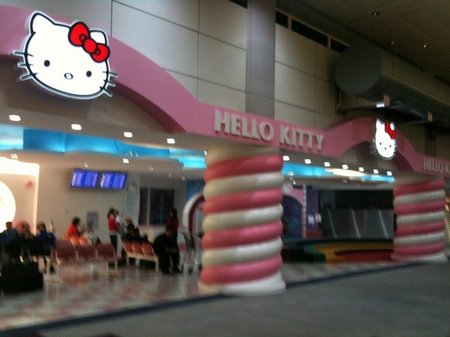
Airports are always looking for new ways to make money, improve wayfinding and make the airport experience more enjoyable. This example from Taipei creates some interesting ideas. I don’t know whether the airport is generating revenue from Hello Kitty branding these departure gates or whether they’d doing it purely as something fun. But consider for a moment the possibilities….

The Hello Kitty branding of these departure gates is not simple signage. They’ve taken the brand onto the columns, the colour of the floor tiles, the seats, walls etc. They have really totally “branded” these gates as a Hello Kitty experience.

That’s obviously not only great for the brand but its also not bad for passenger wayfinding either. OK, I have to admit I wouldn’t be that thrilled with leaving from a “Hello Kitty” gate but I could certainly find it easier. I could also see it very easily and perhaps having seen it, be prepared to spend a little more time in the shopping area as I know more accurately where I have to go to depart.

For the brand its not only very high visibility but it also gives the brand the opportunity to help passengers rather than just building awareness. People are both excited & nervous, happy & sad, enlivened & tired when sitting in a departure gate. This is a perfect opportunity for a brand to genuinely do something of value to them – which we all know these days work far better than simply telling consumers how wonderful a brand is….. prove it.

The New Luxury Signal: Emotional Stability

The New Luxury Signal: Emotional Stability

Luxury resorts used to sell status and spectacle. Now they sell something quieter: relief. Guests arrive overloaded, and the best resorts are redesigning around sensory calm, reduced friction, and emotional steadiness. Modern luxury is less about what you add, and more about what you remove.

When You Can’t Leave: Designing for the Flight Reflex in Airports, Venues, and Hospitals

When You Can’t Leave: Designing for the Flight Reflex in Airports, Venues, and Hospitals

In high-stimulus public spaces, our bodies do more than react – they strategise.
Airports, hospitals, and stadiums all evoke subtle “Flight” responses: scanning, pacing, early exits.
Understanding how threat appraisal drives behaviour can help architects and planners design calmer spaces – and reveal why relaxation, not excitement, predicts dwell, spend, and satisfaction.

Small Towns, Big Relief: Nostalgia, Tradition, and the Break From Self

Small Towns, Big Relief: Nostalgia, Tradition, and the Break From Self

Small towns do more than change the scenery. They give visitors a break from themselves. This piece unpacks how nostalgia and tradition create identity relief that boosts spend, dwell time, and community value. Practical takeaways for tourism, luxury, food, museums, and policy.

The Last Ten Minutes of Luxury

The Last Ten Minutes of Luxury

Guests pay for days yet remember minutes. The peak end rule explains why a stay often lives or dies on one high moment and the day of departure. What works, what fails, and how to design the arc so memory carries your brand home.