If you spend time in a rotary milking shed, something becomes obvious.
Cows aren’t chaotic. They move in patterns. They line up in roughly the same order. They respond to familiar sounds. When the shed is calm and predictable, milk flows easily. When something shifts, loud noise, slippery footing, rough handling, yield drops.
Not because the cow decides to underperform. Because the system changed.
Now walk through a casino.
Humans aren’t chaotic either. They move along illuminated corridors. They respond to familiar sounds and rhythms. They sit. They press. They repeat. When the environment feels contained and frictionless, engagement extends. When interruption or discomfort intrudes, the loop breaks.
Cows and casinos look morally and culturally worlds apart. Structurally, they are not.
Both operate on designed behavioural systems. The difference is what they optimise.
Once you see that, you start recognising the same mechanics in airports, supermarkets, and resorts. Anywhere yield matters.
1. Environment precedes behaviour
In dairy operations, stress is expensive. Cortisol interferes with milk let-down. Agitation reduces consistency. The cow does not compensate with willpower. The system either supports output or suppresses it.
Casinos understand this in a different register. Temperature is stable. Lighting is warm. External time cues are removed. The goal is sustained engagement without anxiety spikes.
Translate this outward.
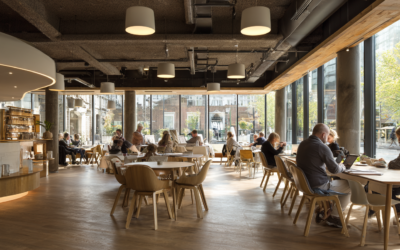
Passengers who feel disoriented in an airport retreat to the gate and stop browsing. Shoppers who feel crowded default to essentials. Resort guests who feel overstimulated withdraw from communal spend areas.
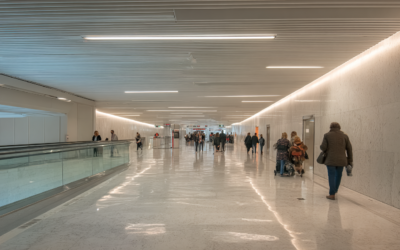
There is hard evidence behind this intuition. A large study across 89 U.S. airports found that a 10 percent increase in passenger dwell time was associated with roughly a 6 percent increase in retail revenue and an 8 percent increase in food and beverage revenue. Terminal design mattered. Layout influenced time. Time influenced spend.
The implication is uncomfortable and simple. Environment alters output.
Milk and margin both respond to stress.
2. Routine reduces cognitive load
Cows prefer predictability. Same time. Same entry path. Same cues. Disrupt the rhythm and hesitation spreads through the herd.
Casinos rely on stable interfaces. Themes change. Mechanics do not. Insert. Press. Spin. Familiarity reduces effort. Reduced effort increases repetition.
Routine is not dull. It is efficient.
Supermarket shoppers depend on spatial memory. When staples are where they expect, mental bandwidth remains available for discretionary purchases. When layouts change constantly, cognitive load rises and browsing shrinks.
Airports position duty-free along natural passenger routes. You don’t need to search. It appears as part of your movement.
Resorts anchor the day in predictable arcs. Breakfast. Pool. Sunset drinks. Dinner. The rhythm creates organic spend windows without overt pressure.
Systems thinking reframes this: behaviour emerges from repeated exposure to stable cues. Stability reduces decision cost. Lower decision cost increases throughput.
3. Variable reinforcement sustains engagement
Behavioural psychology has long shown that intermittent reinforcement produces persistent behaviour. When reward arrives unpredictably, engagement strengthens. The work associated with B. F. Skinner documented this clearly.
Casinos are built on that principle. Not every spin wins. Enough spins win to sustain attention.
Cows respond to conditioning too. Once trained, intermittent cues can reinforce compliance more strongly than constant reward.
Now look at retail and hospitality.
Supermarket loyalty programs increasingly rely on personalised and irregular incentives rather than flat discounts. Surprise matters. Resorts use unexpected upgrades or recognition moments. Airports introduce limited travel-only exclusives that trigger exploratory behaviour.
The mechanism is consistent. Uncertainty sustains attention.
The distinction lies in intent. In dairy systems, reinforcement supports stable production. In casinos, it can sustain dependency. Retail and hospitality sit somewhere between.
The system does not care about morality. It responds to design.
4. Flow determines throughput
Most retailers talk about traffic. Traffic is not flow.
Flow is patterned movement aligned with system affordances. It converts presence into yield.
Watch cows entering a milking platform. The geometry of gates and holding yards determines calmness. Bottlenecks create agitation. Agitation reduces output. Flow is engineered, not hoped for.
Casinos position high-engagement machines along natural walking lines. They intercept movement rather than relying on conscious search.
Airports model passenger movement meticulously. Retail is placed along desire paths between security and gate, not hidden in dead zones. Small design shifts alter how long passengers linger in retail corridors, and linger time correlates with revenue.
Empirical research in retail environments supports this. Lighting, spatial planning, and pathway design significantly influence behavioural intention. Layout is not aesthetic. It is behavioural infrastructure.
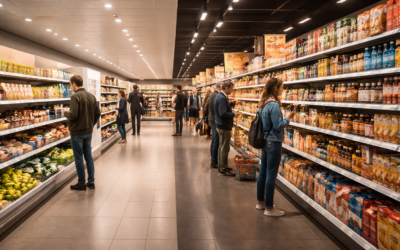
Supermarkets refine flow with almost mathematical precision. Grid layouts guide shoppers past staples toward higher-margin zones. End caps and cross-merchandising create micro-pauses where traffic naturally slows.
Resorts apply the same logic socially. Bars placed between pool and room capture post-activity movement. The guest does not detour. The offer meets them in transition.
From a systems perspective, yield emerges from the coupling of movement and opportunity. Misalign the two and output falls. Align them and throughput increases without coercion.
5. Time perception is a design lever
Milking follows disciplined timing. Physiology responds to rhythm.
Casinos distort time. No clocks. No daylight cues. Engagement extends.
Airports operate under real schedules, yet once security is cleared, design attempts to expand perceived time. The more time passengers believe they have, the more likely they are to browse.
Supermarkets compress time for essentials but expand it around experiential or seasonal zones.
Resorts stretch time deliberately. Longer dinners increase beverage revenue. Sunset rituals anchor high-yield periods.
Time is elastic when designed intentionally.
Systems thinking reframes this as temporal architecture. Perceived time abundance increases discretionary engagement. Perceived time scarcity narrows behaviour to essentials.
6. Stress suppresses yield
A stressed cow produces less milk. That is biology.
A stressed shopper buys defensively. A stressed passenger avoids discretionary retail. A stressed resort guest retreats to private space.
Calm converts.
Across sectors, output is a function of environmental stability and emotional regulation. Stress compresses choice. Stability expands it.
A necessary counterpoint
Of course, people are not cows. Human choice is layered with identity, culture, social signalling, and reflection. Comparing shoppers to livestock risks flattening complexity.
But systems thinking does not deny agency. It locates probability.
A supermarket customer may intend to buy only milk. That intention exists within a designed environment of bakery scent, promotional end caps, and checkout impulse zones. The choice is real. So is the structure shaping its likelihood.
The insight is not that humans are programmable. It is that behaviour emerges within constraints and affordances. Context shifts probability distributions long before conscious reasoning catches up.
The herd metaphor is not about reducing people. It is about recognising patterned response to design.
The strategic question
Cows and casinos are not moral equivalents. They are mechanical equivalents.
Both understand:
Environment shapes probability.
Routine reduces cognitive friction.
Variable reinforcement sustains engagement.
Flow determines throughput.
Time perception alters yield.
Stress suppresses output.
Airports, supermarkets, and resorts apply these principles daily, sometimes consciously, often instinctively.
The distinction is not system capability. It is optimisation intent.
Dairy operations depend on sustainable, repeatable yield. Welfare and productivity align.
Casinos often depend on intensity of engagement.
Retail and hospitality leaders operate between those poles.
When you stop talking about customer unpredictability and start examining your system, the question becomes sharper.
Are you designing for calm, compounding yield?
Or for engineered compulsion that burns attention faster than it builds loyalty?
The metrics will tell you which business you are actually running.