You probably checked the time before you checked the sky.
Your day is divided into measurable units. Meetings at 10. Reporting due Friday. Financial year end. School term. Election cycle. Retirement age.
This feels factual. Neutral. Almost biological.
It isn’t.
For most of human existence, time was experienced through pattern, not precision. Sunrise and season. Flood and drought. Planting and harvest. Ritual calendars that marked meaning rather than minutes. Medieval monasteries formalised prayer hours, but even then time was devotional. It oriented life toward rhythm, not output.
The decisive shift came with industrialisation.
In the nineteenth century, railways forced standardised time across regions. Before rail networks, towns kept local solar time. Noon meant the sun was overhead. After rail expansion, coordination required synchronised clocks. National time grids replaced local variation. Mechanical time moved from church tower to factory wall.
That was not just convenience. It was centralised temporal authority.
When time becomes standardised, labour becomes measurable. When labour becomes measurable, comparison becomes possible. When comparison becomes possible, discipline intensifies. Productivity ceases to be seasonal. It becomes continuous. Output becomes moralised.
This is the world we inherited.
It built extraordinary systems. Hospitals depend on precision timing. Aviation depends on it. Digital infrastructure collapses without it. Chronological accuracy made global coordination possible.
But precision time also narrowed the horizon.
Modern governance elevated measurable, sequential time as the only serious form. Budgets operate in fiscal years. Corporations report quarterly. Governments legislate within electoral cycles. Economic models apply discount rates that mathematically reduce the value of future costs compared to present benefits.
Pause there.
A discount rate is not abstract theory. It is formalised preference for the present. When infrastructure planners evaluate a seawall expected to prevent damage in thirty years, the future avoided loss is discounted. The longer the timeline, the smaller the present value assigned. The mathematics quietly favours deferral.
You see this logic in climate policy.
Australia has repeatedly debated emissions targets framed around 2030 and 2050 benchmarks. Those dates sit comfortably beyond current electoral cycles. Meanwhile, coal approvals are justified through immediate economic return. The time horizon embedded in the decision-making process privileges short-term revenue over long-term ecological stability. This is not simply political cowardice. It is temporal design.
The same narrowing appears in aged care.
Funding debates focus on cost per resident per day, staffing ratios, compliance cycles. Aged care facilities are evaluated through measurable outputs. Yet social isolation remains one of the strongest predictors of decline in older adults. Intergenerational integration programs exist, but they are treated as add-ons rather than structural design features.
If elders are framed as post-productive dependents, then funding becomes containment. If elders are framed as continuity anchors, then integration becomes investment. The temporal lens determines the policy category.
Election cycles reinforce compression. A government investing in preventative health, climate adaptation, or intergenerational infrastructure may not see visible results within a four-year term. Visible, immediate benefits are safer. Invisible resilience is politically risky.
The narrowing of time becomes common sense.
At the individual level, the same compression operates. Busyness signals value. Slowness signals inefficiency. Retirement is framed as economic exit. Ageing populations are described through dependency ratios. You become a burden once your measurable output declines.
Yet human experience does not sit comfortably inside pure measurable time.
Memory collapses decades into seconds. A song, a smell, and twenty years vanish. Trauma disrupts sequence entirely. Ritual suspends ordinary chronology. Grief keeps the dead present. Parents experience responsibility toward children not as abstract future statistics but as immediate moral weight.
Neuroscience shows that remembering the past and imagining the future activate overlapping systems. Psychologically, we already live in layered time. Past and anticipated future continuously shape present behaviour.
Culturally, many societies preserved temporal architectures that institutionalised this layering.
In several Indigenous Australian traditions, the concept often described as “Everywhen” maintains ancestral presence as ongoing obligation. This is not myth as distant prehistory. It is continuity embedded in land and law. M?ori whakapapa binds genealogy to place in a way that keeps ancestors active in identity. Some Native American governance traditions formalise multi-generational responsibility as explicit criteria in decision-making.
These systems differ widely. They are not interchangeable. But they share one structural feature: the past is not finished and the future is not optional.
Modern industrial societies, by contrast, tend to treat the past as archived and the future as speculative.
This distinction shapes legitimacy.
Legal systems privilege documented sequence. Policy debates prioritise measurable outcomes within short frames. Economic models weight immediacy. What fits the clock is recognised. What exceeds it is softened into culture, memory, aspiration.
Clocks feel neutral because they are universal.
But universal tools are the most powerful tools.
The cost of temporal narrowing is not only policy inefficiency. It is moral compression.
When horizons shrink, responsibility shrinks. When responsibility shrinks, continuity fractures.
You see this in burnout culture, where individuals feel rushed yet disconnected. You see it in housing systems prioritising asset acceleration over generational stability. You see it in climate negotiations structured around target years rather than ecological recovery cycles. You see it in aged care systems designed to manage decline rather than integrate continuity.
These are not isolated failures. They are horizon failures.
To question the clock is not to reject modernity. Precision time is indispensable. The question is whether it should remain sovereign.
If the dominant system defines what counts as real time, it quietly defines whose claims expire, whose obligations diminish, and whose future can be discounted.
We rarely examine that authority.
We debate funding, emissions, reform.
We do not debate the temporal architecture within which those debates occur.
Perhaps we should.
Because if our institutions were designed inside a narrow temporal lens, expanding that lens may not be sentimental.
It may be structural reform.
Next, we look more closely at what temporal myopia does to behaviour, trust, and long-term stability when it becomes the air a society breathes.
Other Posts in This Series

The Crisis of Temporal Myopia
How compressed horizons distort decision-making in corporate life, government and personal wellbeing.
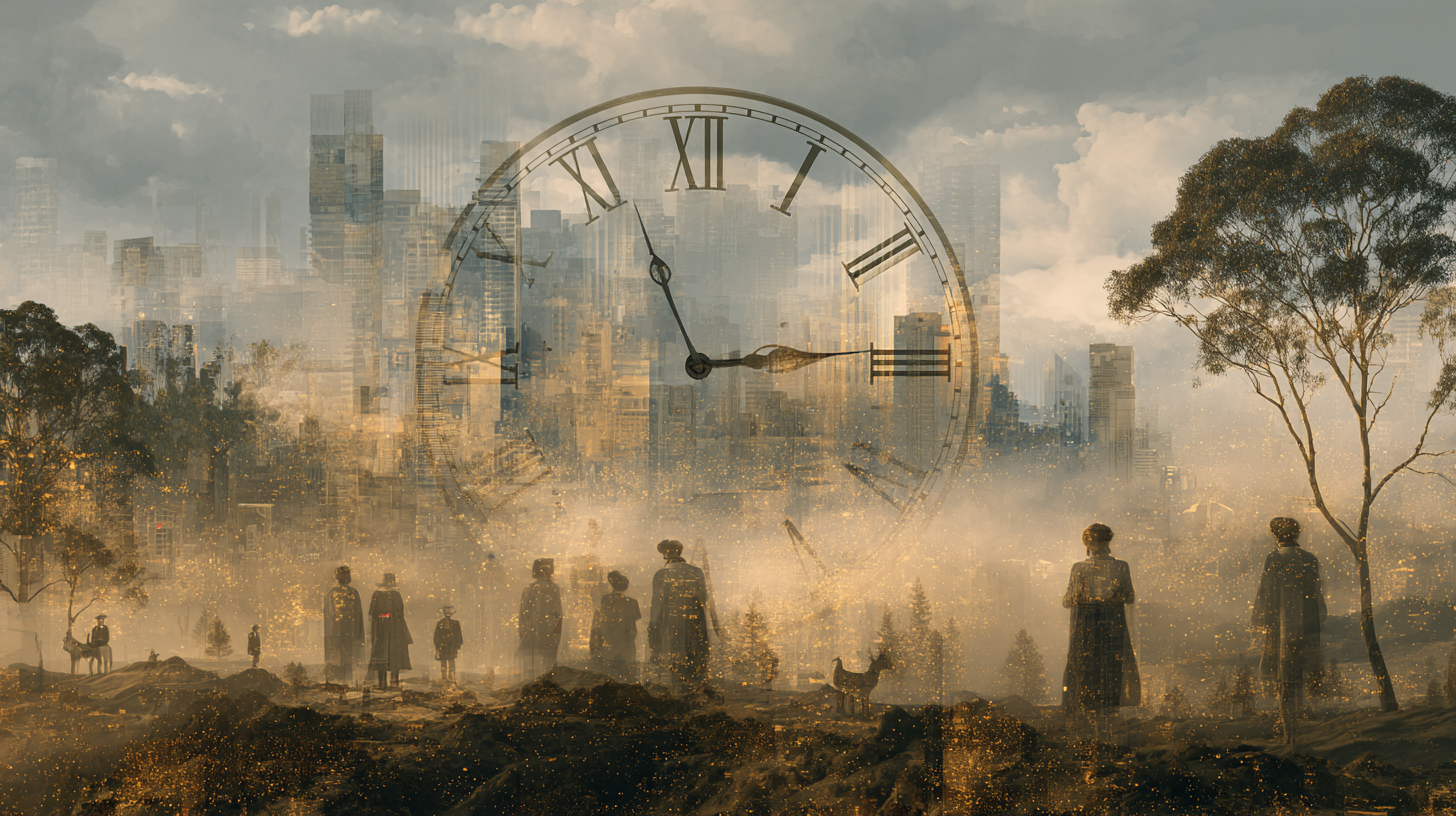
The Politics of Time
What if many of our biggest crises are temporal? This article explores how modern assumptions about time quietly shape aged care, climate policy and governance.