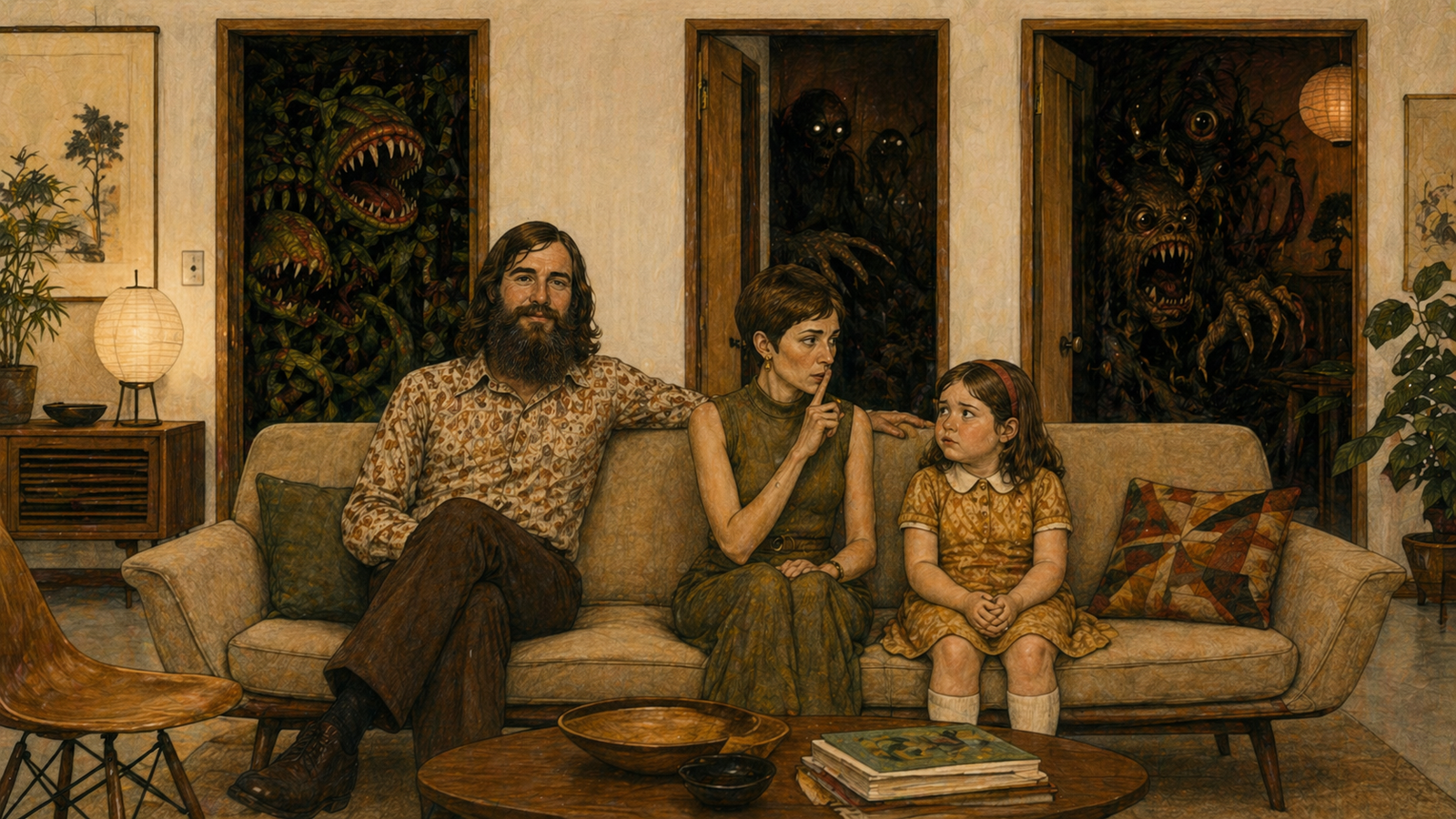
What happens when inherited stories become emotional facts.
There is a moment most people reach somewhere in adulthood, often at a table, often during a story being told for the hundredth time, when they realise the family they grew up in is not the family everyone else remembers.
An event you recall as tense is recounted fondly. A silence you experienced as abandonment is described as distance, or necessity, or protection. Someone’s cruelty becomes someone else’s discipline. Someone’s absence becomes someone else’s sacrifice. You begin to wonder which of you is misremembering, and slowly understand the more unsettling possibility: that no one is.
Nobody is consciously lying. That is the part that takes longest to accept.
We tend to imagine false narratives are built on purpose, as though families convene to engineer propaganda against one another. The reality is quieter and more human. A child absorbs emotional conclusions long before developing the reasoning to test them. They learn who is difficult, who is fragile, who is selfish, who is reliable, well before they are old enough to weigh the evidence. The emotional architecture arrives first. The facts arrive later, if they arrive at all. By then the narrative already has roots.
This happens because families are not courts of law. They are survival systems, and their primary purpose is stability, not accuracy. Children are exquisitely tuned to this. They learn which version of events keeps the household coherent, which interpretations preserve attachment, which stories lower the temperature in the room. Complexity threatens that equilibrium, because complexity dissolves certainty, and certainty feels safer than ambiguity to people who depend on one another to function.
So the narratives compress. One parent becomes the problem. One sibling becomes the dramatic one. One relative becomes cold, or ungrateful, or unstable. And once a role is assigned, it quietly begins editing everything that follows.
Most people do not inherit objective family histories. They inherit emotionally interpreted versions of events.
This is the mechanism worth slowing down on, because it does almost all the damage. We are pattern-completion creatures. Hand us a frame and we will spend years furnishing it, noticing the details that fit and waving away the ones that don’t. In academic language this appears as bias. Inside a family it feels like truth. A child who is repeatedly told that someone is selfish will read that person’s neutral behaviour through the inherited lens for the rest of their life. Distance becomes rejection. A boundary becomes cruelty. Confusion becomes manipulation. Every new interaction is filed as further proof of a verdict reached before the evidence was ever in.
Eventually the story stops feeling like a story.
It becomes identity. People end up defending not merely a version of events, but a version of themselves that requires those events to stay fixed. This is why family conflict is so resistant to resolution. The conflict is almost never about the incident on the table. It is about the entire emotional map the incident is being slotted into, and maps, once internalised, are difficult things to redraw.
None of this stays inside the family. The same machinery runs through nations, religions, political movements, companies, group chats. We inherit simplified moral frameworks from every system we belong to, because nuance is expensive and certainty is cheap. Whole societies rest on inherited convictions that very few members ever pause to examine. History, read closely, is less an objective record than an ongoing negotiation between competing memories, each shaped by power, shame, loyalty, and the simple need to keep going. The most durable stories are rarely the most accurate. They are the ones that best preserve emotional coherence for the people telling them.
That preservation has a cost, and it is not the one people expect. The danger is not that anyone turns evil. It is that certainty crowds out curiosity. The moment we feel morally settled about another person’s character, the part of us capable of imagining their interior life goes quiet. They stop being fully human and contradictory and become a fixed position in our personal mythology. The selfish son. The unstable sister. The manipulative ex. The absent father. The difficult mother. People are far easier to judge once they have been reduced to their function in someone else’s narrative.
What makes this so hard to dislodge is that the narratives are usually built from real material. Two people can live in the same house and leave with opposite histories, both true. One child remembers safety where another remembers fear. One reads emotional distance as coldness, another as restraint. Memory is not archival footage; it is reconstructed each time it is recalled, coloured by everything that has happened since. This is not an argument that truth is unavailable. It is a recognition that our access to it runs through attachment, fear, and loyalty before it reaches us, and that the route changes what arrives.
We are not, as a culture, comfortable with that. We have grown to prefer moral clarity, clean casts of heroes and villains, victims and perpetrators, good families and bad ones. Reality is less obliging. People wound each other while feeling entirely justified. Parents fail children in the act of trying to protect them. Children misjudge parents they will later come to resemble. Siblings walk away from the same dinner table carrying different countries’ worth of history. Most families run on edited records and protective omissions, and some of those edits hold for so long that questioning them comes to feel like betrayal.
Maturity, when it actually arrives, is largely the capacity to hold that complexity without sliding into cynicism. To accept that someone else’s experience might contain a truth that threatens your own, and that admitting this does not require surrendering your own. It asks for humility, and for the harder admission that being close to a story has never guaranteed understanding it.
There is, right now, a version of you living inside other people’s minds. It was assembled partly from what you did and partly from narratives you never wrote and cannot revise. Some of those versions are fair. Some are incomplete. A few are badly wrong, and you will likely never know which. That is not yours to control.
What remains yours is narrower, and more demanding: whether you stay curious enough to keep questioning the stories that reached you before understanding ever did, including the ones you tell about yourself.