 Here’s another reason why dieters should avoid all-you-can-eat buffets: When faced with a large variety of items, consumers tend to underestimate how much of each item is present, according to a new study in the Journal of Consumer Research.
Authors Joseph P. Redden (University of Minnesota) and Stephen J. Hoch (University of Pennsylvania) investigated consumers’ perceptions of quantity in a set of experiments that may help us understand how quantity perceptions influence portion sizes.
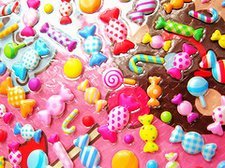
“Does a bowl with both red and blue candies seem to have more or less than a bowl with only one color candy?” the researchers asked. “Contrary to popular belief, the presence of variety actually makes it seem like there are fewer items.”
To investigate the question, the researchers first exposed participants to images of colored dots and geometric shapes. “When items differ, people tend to focus on one type or the other, and find it difficult to merge the multiple types into a whole,” the authors write. “However, a set composed of only identical items makes it easy for people to perceive the items as a single, unified whole.”
The authors found that focusing on the larger whole makes a set appear to occupy more space. “Since people rely on spatial area as a cue for quantity, a set appears to have more items when they are all identical.” After demonstrating this perceptual effect in two studies with geometric shapes, the researchers moved on to food.
When participants were asked to pour food into containers, they poured more when the candy had a variety of colors. “This occurs even though people knew they could not consume the candy,” the authors add. “Specifically, people pour more in the presence of variety since they perceive lesser quantities.”
The authors believe that consumers’ tendency to underestimate portions in the presence of variety may explain peoples’ tendency to eat more if there is greater variety in a meal. “This misperception causes people to pour larger servings when there is variety, yet they don’t realize they have done so,” write the authors. “Since prior research has shown that people eat most of what they serve themselves, variety could lead people to eat more solely due to this perceptual influence.”
Understanding these visual tricks may help people get a handle on portion control, a key element in reducing obesity.
More information: Joseph P. Redden and Stephen J. Hoch. “The Presence of Variety Reduces Perceived Quantity.” Journal of Consumer Research: October 2009.
Source: University of Chicago
Photo : Porcelaingirl/Flickr