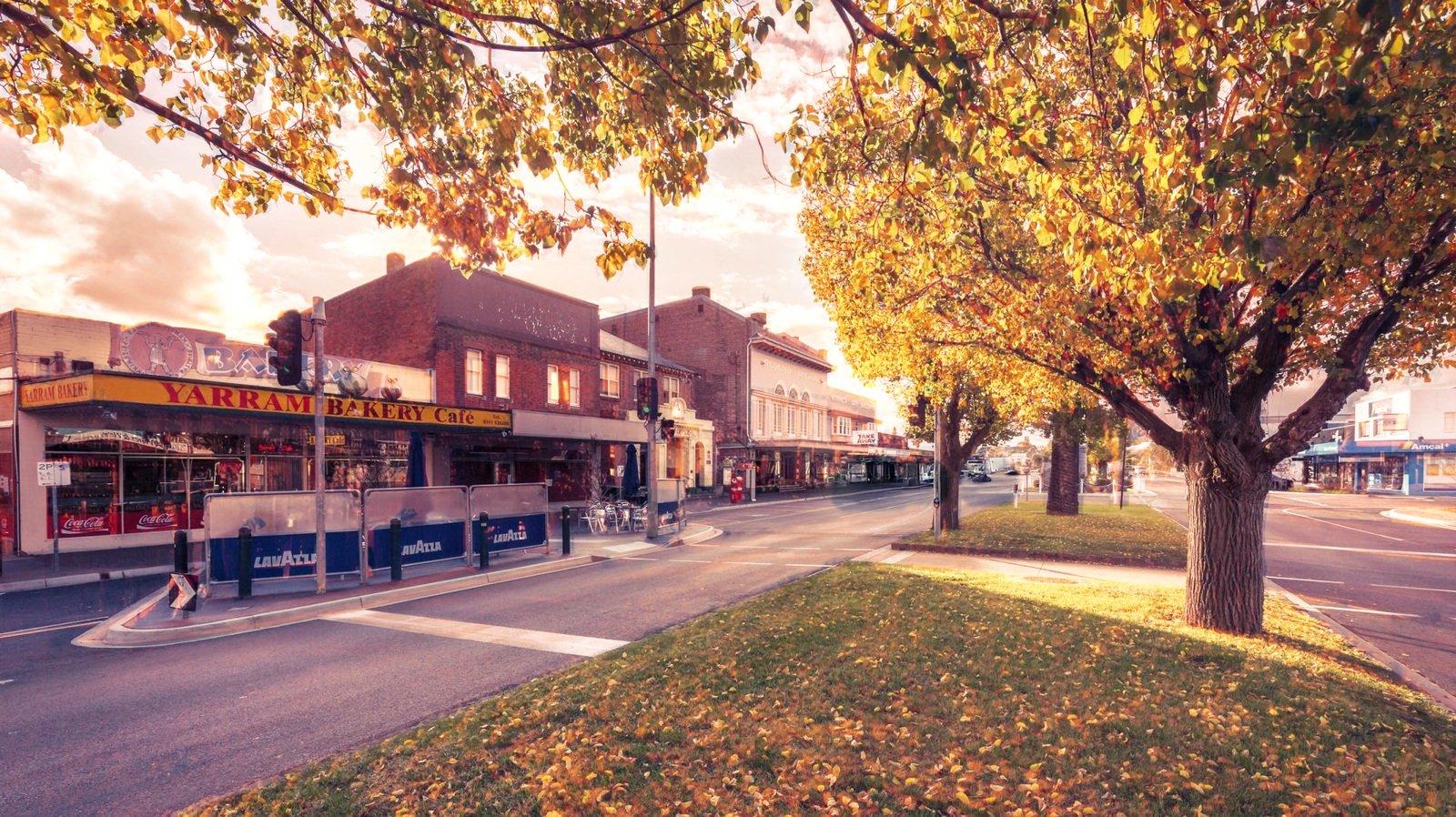
On the corner of the main street sits a café that has been there for decades. It serves what locals have always eaten: thick-cut chips, stuffed spuds loaded with cheese and bacon, milkshakes in every colour, and coffee that comes in a mug rather than a glass vessel that looks like it belongs in a lab. It is always full. The same faces drift in each morning, farmers in work boots, shop assistants before a shift, pensioners with time to linger. Tourists follow the crowd. They queue at the bakery for meat pies and enormous vanilla slices, or at the corner café for a spearmint milkshake that feels like a time warp.
Down the street a newer café tells a different story. Opened by newcomers, it has polished timber tables, sleek branding, and a menu of multigrain sourdough toasties with microgreens, turmeric lattes with oat milk, and cakes designed to look good on Instagram. It was imagined as a place for both city migrants and tourists who wanted the food they were used to in Melbourne or Sydney. For a few weeks it was busy. But slowly the numbers dropped. Tourists discovered that if you wanted to meet locals - to really feel the town - you had to eat where the locals ate. Migrants kept stopping by, but fewer each month. The new café struggled, changed menus, brought in a special chef, and tried again. But the rhythm of the town was elsewhere.
This is the paradox of migration into small towns. People move seeking difference - quiet, space, affordability, the texture of a life that isn’t the city. But once they arrive, many try to remake the place they’ve chosen into the place they left. Wine bars, designer cafés, development programs, boutique festivals. Sometimes they thrive for a season. More often, they flicker and fade.
I know because I arrived like that myself. Fourteen years ago I came full of ideas, armed with experience from large-scale business and events. I could see all the things the town “lacked” and believed I had the skills to fill those gaps. I joined committees, reshaped events, pushed tourism strategies. When I faced resistance, I kept pushing. It felt obvious: the town had potential, why wouldn’t you want to realise it?
But in time I learned the lesson most newcomers discover the hard way: it’s not “best” if it’s not what the community wants. A town is not a blank canvas. It’s an ecosystem of culture, values, and memory. You can bulldoze through with enough energy - and enough newcomers by your side - but that doesn’t mean you’re building something sustainable, or something the locals actually want to live in. Or even something you ultimately want. Because often you end up destroying the very qualities that attracted you to the town in the first place. The simple reality is you can’t have it all - you can’t have all the amenities of Melbourne and still keep the quaintness, restraint, and community-mindedness of a small country town.
Whose town is it?
Over time, enough newcomers arrive to give their opinions a kind of density. What once felt like a trickle becomes a tide. Community groups and development programs get steered by new people with new values. Locals often retreat into bastions of “old guard” identity - the footy club, the CFA, the RSL, the church hall - leaving the broader town culture to be reshaped. Bit by bit, the town loses some of the characteristics that made it unique.
The question becomes unavoidable: whose town is it? The one defined by generations of continuity, or the one reshaped by the critical mass of new arrivals?
This isn’t only a Victorian story.
- In Byron Bay (NSW), counterculture migrants transformed a sleepy surf town into a global lifestyle brand. The surf club still stands, but property prices have pushed out many families who once anchored the place.
- In Bellingen (NSW), environmentalists and artists remade a dairy town into a festival capital, celebrated but also contested.
- In Maleny (QLD), hinterland traditions collided with new-age migration, reshaping the identity of the main street.
- In Stanley (TAS), heritage and fishing culture now sit in tension with tourism branding.
- In Margaret River (WA), a surf town became a wine-tourism hotspot, balancing global branding with the grit of its original community.
Across the country, the pattern repeats. Migration brings renewal and risk. The very thing that draws people in - authenticity, character, the feel of difference - is eroded by their arrival if not carefully handled.
Why the clash is structural
Three different lenses help explain why this keeps happening.
Hofstede: Small towns lean toward collectivism, flat power distance, and long-term horizons. Belonging is measured in decades, not quarters. Newcomers often bring a culture of individualism, hierarchy, and short-term goals. The café example makes this clear: one place orients around continuity and community, the other around novelty and individual choice.
Drucker: Peter Drucker wrote that management is a social function as much as an economic one. Leadership in a town is legitimate only when it is socially accepted. Newcomers often confuse energy with legitimacy. They can gather votes, launch events, open businesses. But if they lack social legitimacy, what they build rarely lasts.
Ansoff: Igor Ansoff’s turbulence theory explains the mismatch in tempo. City migrants are turbulence-trained, used to discontinuous change and rapid adaptation. Small towns are stability-trained, calibrated for seasons and generations. When turbulence collides with continuity, mistrust grows.
The paradox of absence
One of the most important insights is that what makes small towns attractive is not only what they have, but what they lack.
The absence of fast food chains. The absence of boutique density. The absence of constant novelty. These absences are part of the culture. They are what create the texture of small-town life - the very thing people claim to be moving for.
When newcomers succeed in erasing those absences, they also erase the uniqueness that drew them there. It becomes possible to ask: if you wanted Melbourne’s cafés, festivals, and wine bars, why not just stay in Melbourne?
What belonging requires
None of this means small towns should resist all change. Culture is never static. Migration does bring energy, skills, and renewal. But the way newcomers enter matters.
Belonging requires a different rhythm:
- Listen first. Ask what locals want to achieve for their town.
- Adapt second. Fit into the rhythms of continuity - the footy club, the hall, the old café.
- Offer third. Only once legitimacy is earned should new ideas be introduced.
This is the same lesson big business must learn when it enters regional towns. Cultural due diligence is as important as financial due diligence. If you skip it, you might succeed for a season, but you’ll fail in memory.
Small towns are not fragile, but they are finely tuned. Their identity lies not just in what is present but in what is absent - the quiet, the restraint, the continuity.
Urban migrants arrive seeking those very qualities, yet often risk erasing them in their drive to improve. The irony is that in trying to have it all, they can end up with something less: a place that is neither fully city nor fully country, but a diluted in-between.
The real challenge is not whether towns can adapt to newcomers. It is whether newcomers can adapt to towns - to learn humility, patience, and care.
Because in the end, belonging is not claimed. It is earned.
The Hardest Story to Question Is Your Own
It is easy to accept that perception, memory and interpretation are imperfect in the abstract. The difficult part comes when a particular piece of evidence unsettles the account we have used for years to explain ourselves, another person or the course of our life.
When Story Becomes History
Groups do not remember in the same way individuals do. Families, organisations and nations preserve records, repeat stories and inherit assumptions. Information can survive while its meaning fades, leaving institutions technically in possession of the past but unable to learn from it.

The Characters in My Story
Our life stories contain other people, but we rarely possess their full story. We observe behaviour, infer motives and assign meaning. Over time, those interpretations can become so familiar that we forget which parts were witnessed and which parts were supplied by us.
The Person I Need to Be
We do more than remember what happened. We organise events into an account that explains who we are, how we became that person and what kind of person we expect ourselves to be next. Identity shapes memory, but memory also helps maintain identity.
Memory Is Not an Archive
Memory feels like retrieval, as though the past has been stored somewhere intact. It is closer to reconstruction. Each act of remembering draws on surviving fragments, later knowledge, emotion and the meaning an event has acquired since it happened.
The Unreliable Witness
We tend to think memory is where our account of an event becomes unreliable. But the process begins earlier. Attention is selective, perception is incomplete, and two people can experience the same event while noticing very different things.

The Child Who Became the Mask
Some forms of imposter syndrome are not about confidence. They are about authorship. For those shaped by rejection, secrecy, abuse, or parentification, the deeper wound may be the inability to feel legitimate inside their own competence.

Deciding Under Constraint
The data is good. The model is sound. And the decision still doesn’t hold the way it should. The problem isn’t the analysis. It’s what the analysis assumes about the stability of the world it’s describing.
The Version of You Other People Carry
Families do not always pass down facts. They pass down emotional maps. This essay explores how inherited stories become certainty, how certainty crowds out curiosity, and why maturity asks us to question the narratives we absorbed before understanding arrived.
Why Institutions Feel Slower Than the World Around Them
The frustration with institutions isn’t wrong. But the explanation usually is. The problem isn’t political will or institutional timidity. It’s a design built for a world that no longer exists.